DRIFT: Drift-Resilient Invariant-Feature Transformer for DGA Detection
Authors: Chaeyoung Lee*, Chaeri Jung*, Seonghoon Jeong (*Co-first authors)
Role: Co-first Author (Model Implementation, SSL Pipeline Setup, etc.)
Lab: SNSec Lab (Sookmyung Women’s University)
Project Summary
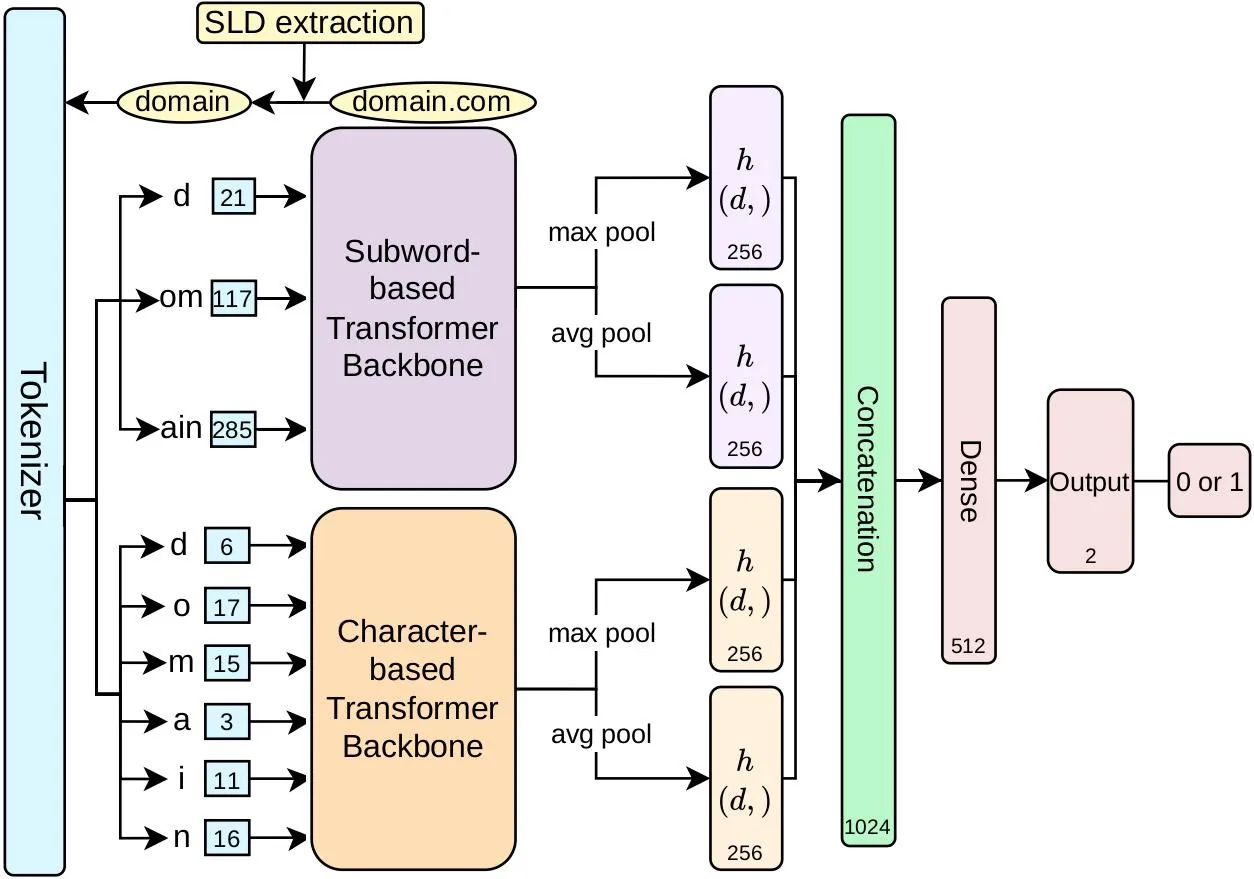
This project introduces DRIFT, a Transformer-based framework designed to tackle Temporal Drift in DGA detection. By combining a hybrid tokenization strategy with multi-task self-supervised learning, DRIFT learns invariant features that remain robust even as botnets evolve over time.
Key Contributions
- Hybrid Tokenization Strategy: Combines character-level and subword-level encoding to capture both stochastic morphological patterns and word-based DGA structures.
- Self-Supervised Pre-training: Utilizes three multi-task pre-training objectives to learn contextual and structural features from unlabeled data.
- Longitudinal Study: Evaluated through a 9-year longitudinal study (2017-2025), demonstrating superior performance against state-of-the-art character- and word-based classifiers.
The Problem: Temporal Drift in DGA
Most DGA (Domain Generation Algorithm) detectors perform exceptionally well on datasets they were trained on. However, in the real world, botnets evolve. Through our 9-year longitudinal study (2017-2025), we observed that even state-of-the-art models suffer from significant performance degradation as new DGA variants emerge—a phenomenon known as Temporal Drift.
Our Solution: DRIFT
To mitigate this, we proposed DRIFT (Drift-Resilient Invariant-Feature Transformer). Instead of just memorizing current patterns, our framework focuses on learning invariant representations that stay robust over time.
Core Methodology
-
Hybrid Tokenization Strategy: DGA domains can be purely random (character-based) or dictionary-based (word-based). DRIFT uses a dual-branch encoder that processes both character-level and subword-level tokens simultaneously to capture diverse morphological structures.
-
Multi-task Self-Supervised Learning (SSL): To make the model smarter without requiring labeled data, we used three pre-training tasks:
- Masked Token Prediction (MTP): Learns local dependencies by predicting hidden tokens based on the rest of the domain name.
- Token Position Prediction (TPP): Encourages the model to learn the global structure and correct ordering of tokens within a domain name.
- Token Order Verification (TOV): A sequence-level binary classification task that teaches the model to discriminate between coherent and scrambled domain names.
Tech Stack & Methodology
- Language: Python
- Library: PyTorch, HuggingFace (transformers & tokenizers), Polars
- Architecture: Transformer-based Dual Branch Architecture
- Evaluation: Forward-chaining evaluation, Drift analysis
Results
Our comprehensive evaluation shows that DRIFT significantly mitigates performance degradation over time compared to existing baselines. By learning invariant features, the model remains effective even as new DGA variants emerge.
Quick Links
- Code Repository: GitHub - snsec-net/2026-DSN-DRIFT
- Dataset: Download Dataset via IEEE dataport
- Official Paper: 추가 예정
For more details, you can check the full paper or contact me.